Robert Ryman & Mario Schifano: Standard / Variations
|
Gallerie d'Italia Milano — Ryman / Schifano: Standard / Variations Caveau at Gallerie d’Italia, Milano Curated by Nicola Ricciardi
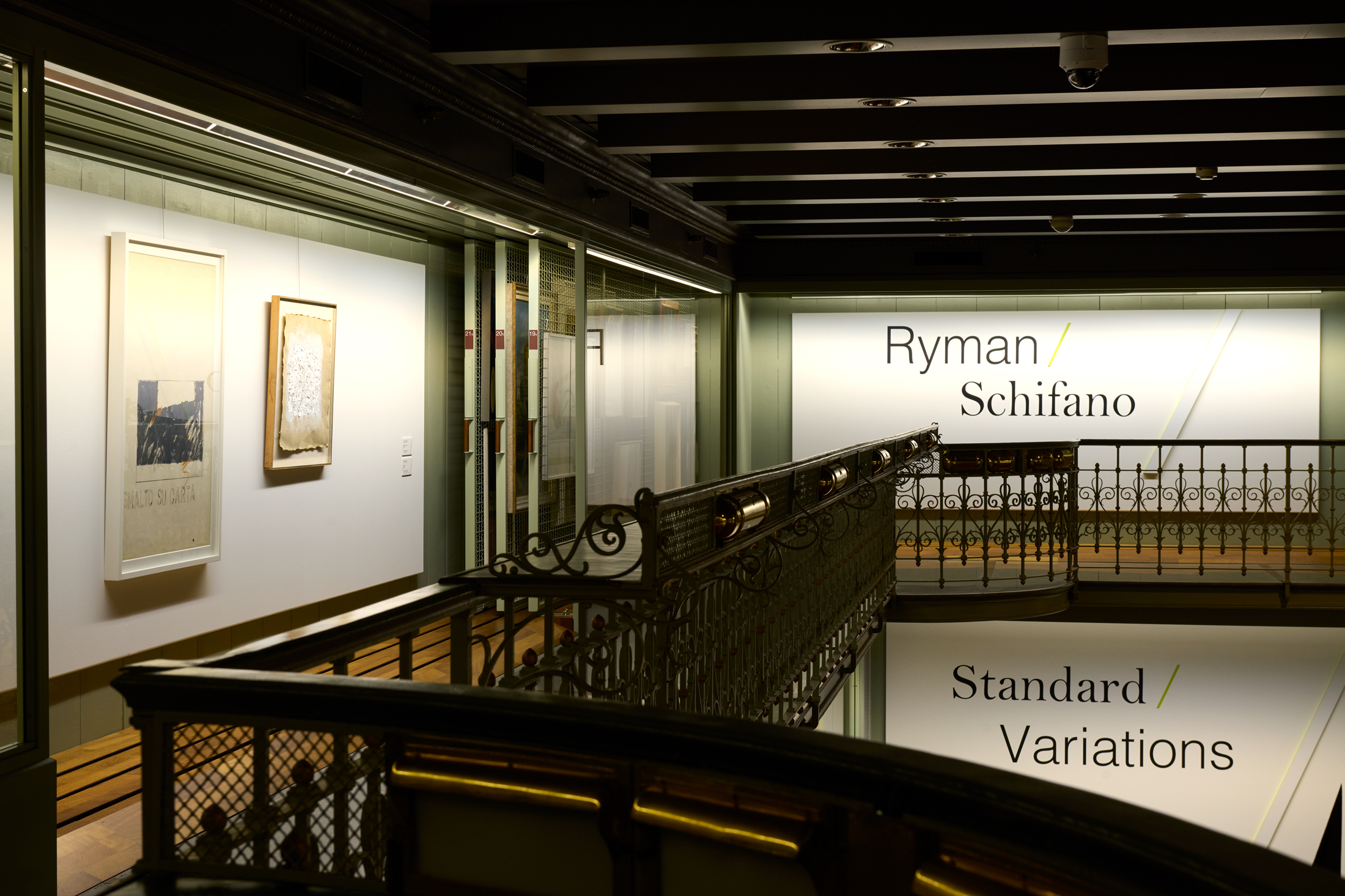
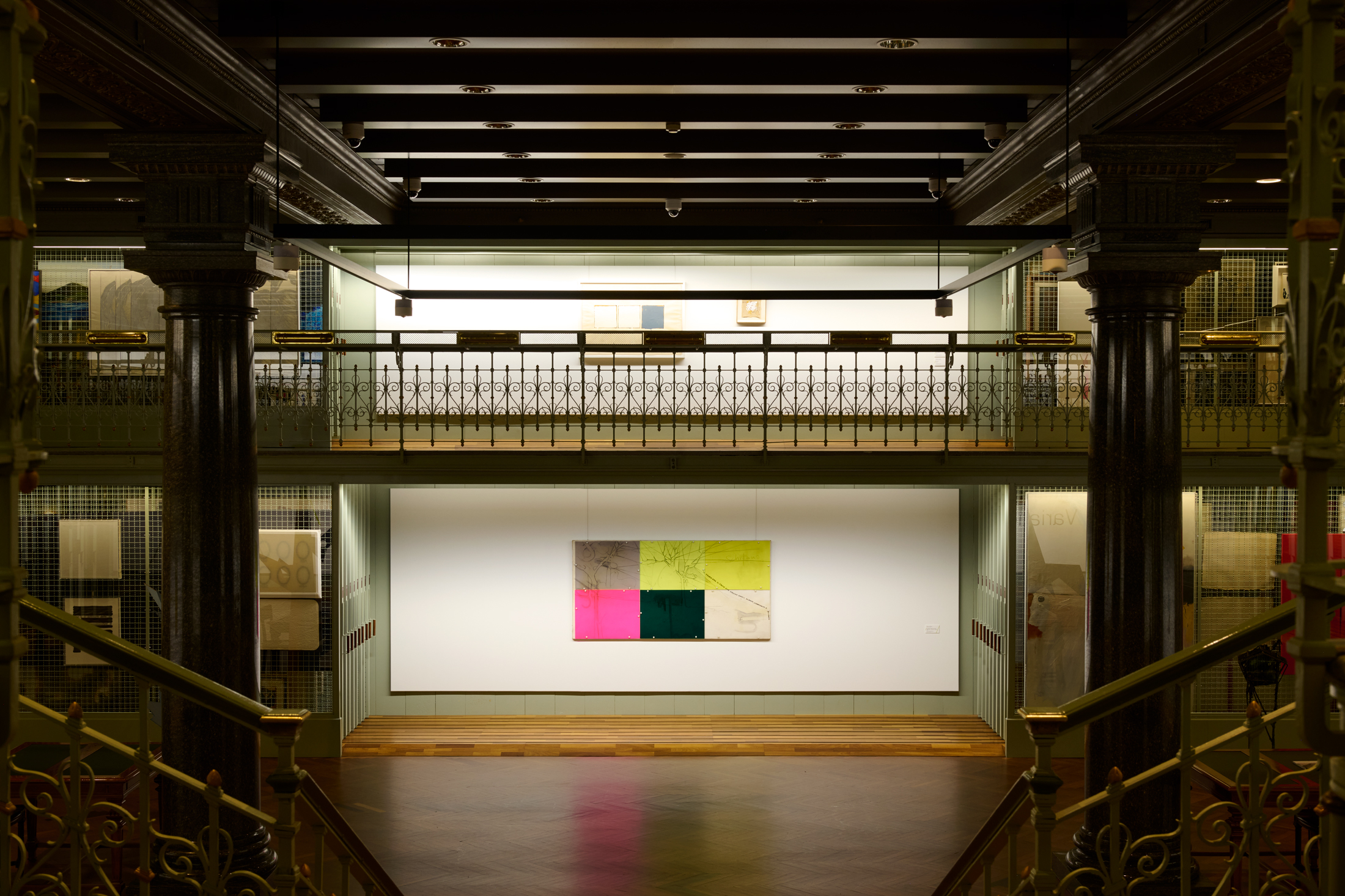
In the 1960s, between New York and Rome, two seemingly distant practices—painting and jazz—shared a common urgency: to refound language from within, without destroying it. This was not a matter of wiping history clean, but of shifting its weights, reducing its assumptions, making visible the conditions of making, and finding in repetition the exact point at which form ceases to be formula and becomes research once again. It is within this field of forces that the project Standard / Variations relates the work of Robert Ryman (1930–2019) and Mario Schifano (1934–1998), taking the evolution of modal jazz—and in particular the turning point represented by Miles Davis (1926–1991)—as both a key for listening and an operative model. Modal jazz emerged when traditional harmonic progression—the chain of chords guiding improvisation—became rarefied, leaving space for one or two stable modes: an essential structure that does not prescribe, but enables. In Kind of Blue, the seminal 1959 album often considered the first modal album in jazz history, as well as in contemporaneous explorations, Davis inaugurated an idea of freedom that did not coincide with excess, but rather with breath. Here, micro-variation, intensity distributed over time, attention to timbre and to the quality of attack ask the listener to draw closer, to accept that “almost nothing” can be “a great deal.” Although today they are considered as belonging to very different critical contexts—Schifano close to Pop Art and European post-Informel, Ryman to American Minimalism—their painting, in those same years, was carrying out an analogous transformation. For both artists, the study and application of monochromy was neither an endpoint nor a gesture of neutralization, but rather the choice of a reduced grammar through which minimal differences, surface decisions, and margins of possibility could become legible. In both cases, the painting was reconfigured as a temporal field, where what matters is not what it represented, but how it happened. For Ryman, the choice of white—already stabilized by the end of the 1950s—was a device of concentration, allowing him to bring the constitutive elements of painting to the foreground: support, grain, thickness, density, the layering of applications, and the physical relationship with the wall. The painting is not a window, but an object: for him, “the image is the color, the process, the brush, the way the painting is made.” This principle is particularly legible in the three works from the Luigi and Peppino Agrati Collection, displayed in the vault of Gallerie d’Italia in Milan, all three titled Untitled (1961, 1962, 1963). Linen canvases not tamed by traditional preparation; edges that allow the raw canvas to emerge; differences between compact and rarefied applications; minimal chromatic insertions—a chalky blue, an orange, or a gray that appear as accents. Each painting is a variation on a set of almost constant conditions, like a modal chorus traversed by infinitesimal changes in phrasing.
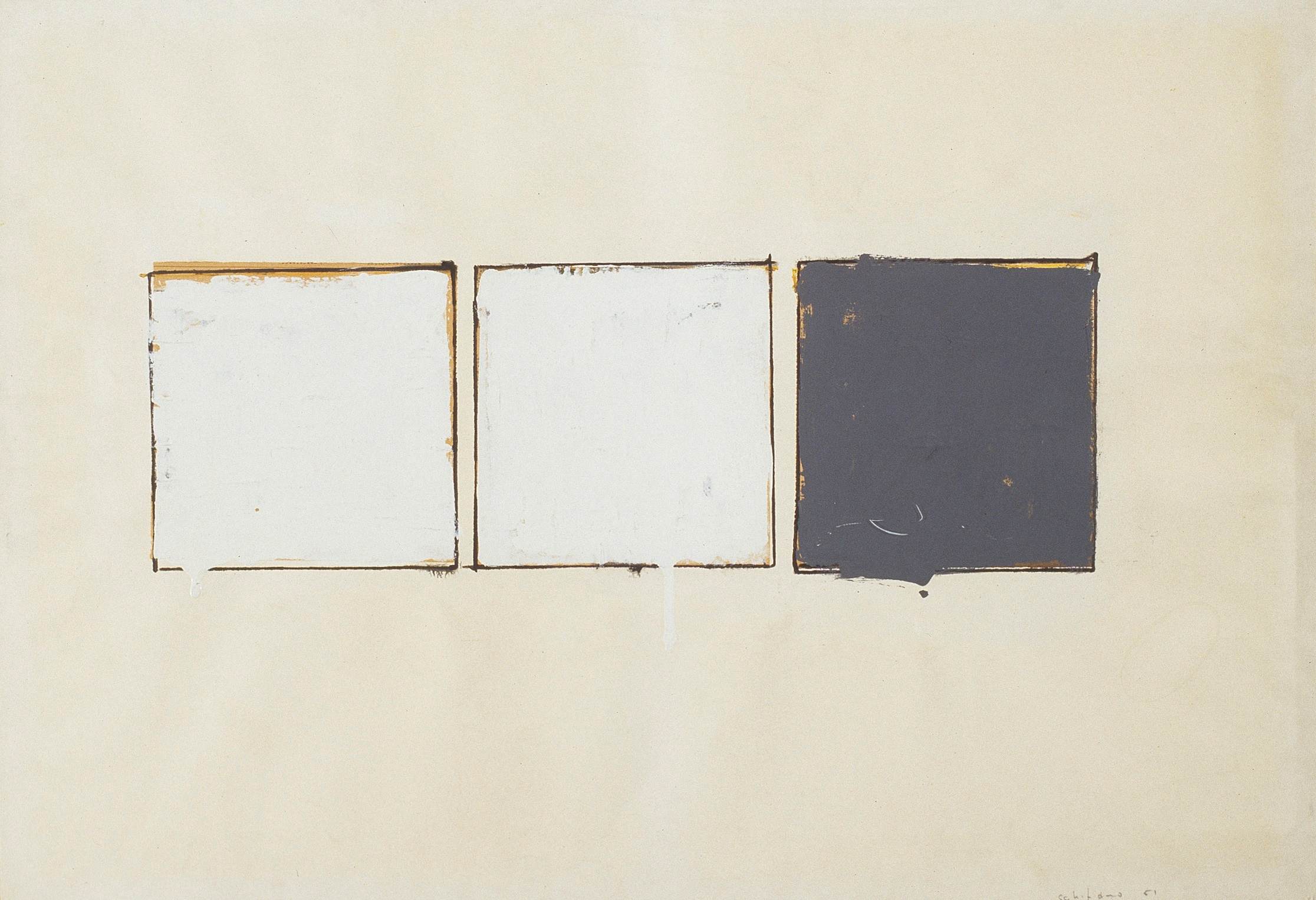
Schifano, in a different context and with a more exposed intensity, made a related move: after an Informel phase still perceptible at the end of the 1950s, around 1960 he arrived at monochrome painting—or painting reduced to two colors—often in enamel on mounted paper, with drips and marks that do not erase manual execution, but place it in tension with the idea of the “screen.” In works such as Propaganda (1960)—which symbolically opens the route through the vault—the surface seems to construct a virtual frame with rounded corners. It is a rectangle within a rectangle that evokes cinema, television, and the slide. It is not yet Pop in the fully iconographic sense, but an earlier reflection on the technical and public conditions of the image, on the way painting might once again measure itself against the outside world without falling back into traditional representation. The years 1961–1963—also represented in the exhibition by Untitled (1961) and by works on paper in which the palette is reduced to black and white with minimal chromatic additions—show Schifano pushing painting toward a productive tautology: titles and inscriptions, such as Enamel on Paper, that name the technique and, in doing so, shift meaning beyond the visual limits of the work. In Le cose che appartengono a tutti (The Things That Belong to Everyone, 1963), fragments of signage and almost indecipherable words—up to the re-emergence of “Coca Cola”—function as samples. They are not yet pop icons to be consumed, but clues to a collective, impure, continuously rewritten language. Here the relationship with modal jazz becomes precise: Davis, too, works on common material—the standard—in order to produce shifts in perception; Schifano, in his own way, works on public alphabets and screen-surfaces so that painting can absorb the rhythm of the present without illustrating it. The vault of Gallerie d’Italia thus becomes a close listening chamber, an environment in which reduction is not austerity, but sensitization. On the one hand, Ryman refines painting as a practice of attention: a discipline of the how—“it is never a question of what to paint, but only of how to paint.” On the other, Schifano transforms the surface into a montage device: from monochromes and technical tautologies, within a few years, he moves toward shifts into landscape and writing, arriving at works such as Paesaggio anemico (Anemic Landscape, 1965) or Il vento era il fiato che usciva dagli alberi, composto e salubre (The Wind Was the Breath Coming Out of the Trees, Composed and Healthy, 1965), where the natural datum is mediated and broken down into analytical, almost semiotic fragments, between description and schematism. This first section of the exhibition project then enters into dialogue, in the Manzoni Room located on the floor above the vault, with a point of maximum intensity and clarity: Robert Ryman’s monumental Surface Veil IV, also from the Luigi and Peppino Agrati Collection. Immersed in such a museum and institutional context, the work makes it even more evident that painting is not simply a genre or an image, but a spatial and material fact, almost spiritual, in a relationship among light, physicality, gesture, and viewing time that makes the experience not unlike that of listening to live jazz.
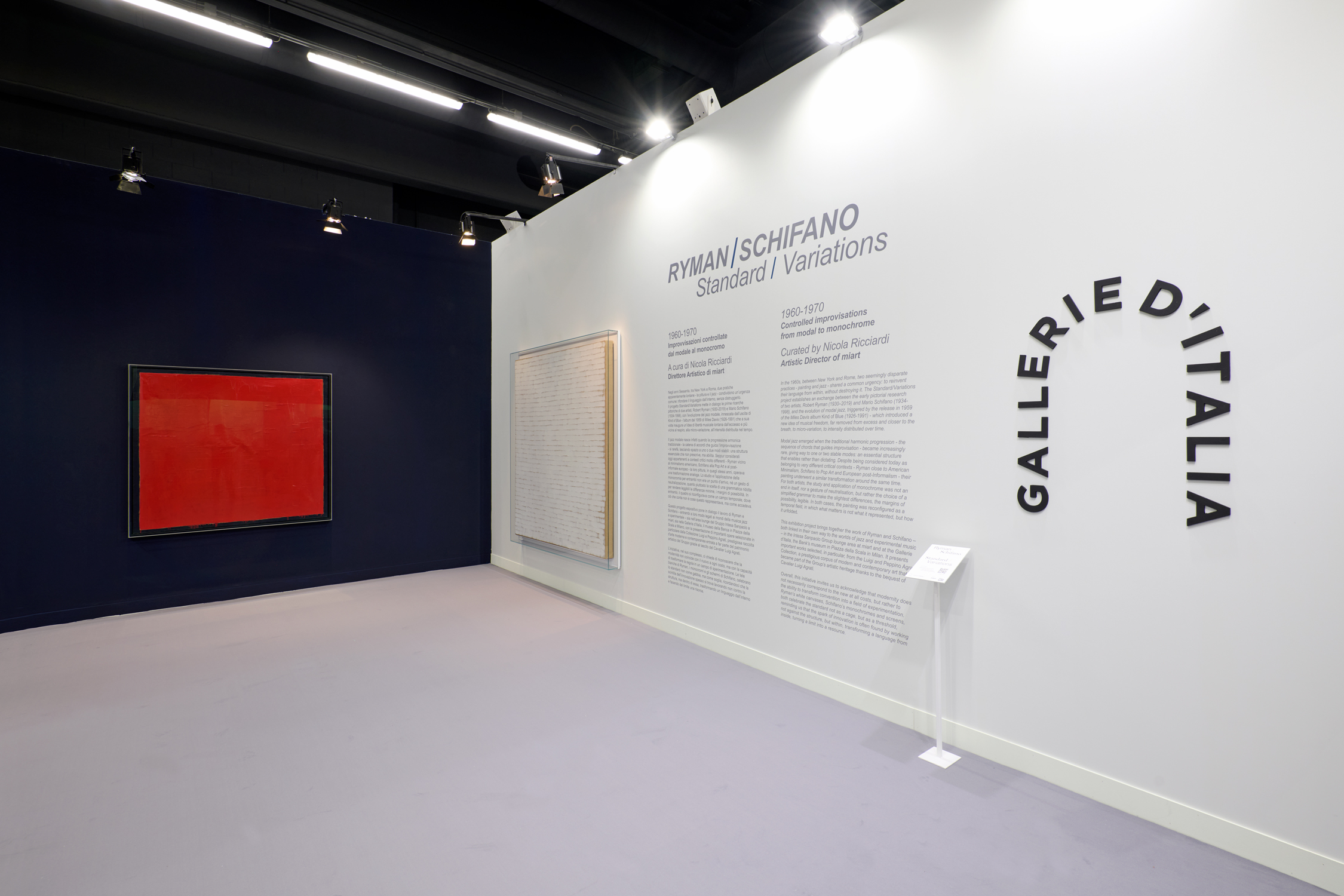
Finally, just as jazz by its very nature tends to diverge from predetermined tracks, this exhibition also moves beyond its own museum standard to enter another context. The exhibition continues inside miart, the international modern and contemporary art fair organized by Fiera Milano, and specifically in the Intesa Sanpaolo Group lounge area, where two pure monochromes are presented: Mario Schifano’s red Analogo (1961) and Robert Ryman’s white Winsor 20 (1966). If the vault focuses on research as laboratory, here a dialogue is activated in keeping with the curatorial theme of the fair’s thirtieth edition, New Directions, which takes jazz not as a conceptual decoration but as a paradigm: stimulating controlled improvisations within a shared structure, preserving the intelligibility of the fair-form while at the same time preventing it from stiffening into formula. After all, in the history of the twentieth-century avant-gardes, few artistic practices have embodied the idea of modernity as precisely as jazz: a form capable of transforming tradition into a laboratory, of making rule a premise and deviation a method. In this tension—between structure and risk, between repertoire and invention—we can also recognize a fertile matrix for contemporary art, still grappling with the same question after more than sixty years: how to innovate without severing the conditions of intelligibility; how to push a language beyond its own standards without dissolving it. In this sense, the relationship among Ryman, Schifano, and Miles Davis is not a game of analogies, but a proposed reading. There is, finally, a biographical detail worth mentioning, one that turns the parallel into a real contiguity: Ryman arrived in New York in 1952 with the ambition of becoming a jazz saxophonist, later bringing into painting that form of “structured improvisation,” made of calibrated variations and measured gestures. For Schifano too, who often conceived the painterly gesture as a visual action in dialogue with sound, an interest in music was anything but marginal, as demonstrated by the band he founded in the second half of the 1960s—Le Stelle di Mario Schifano—and by his frequent collaborations with the Italian experimental scene, beginning with Stormy Six. Taken as a whole, this project asks us to recognize that modernity does not coincide with novelty at any cost, but with the ability to transform the rule into a field of experimentation. In the rooms of Gallerie d’Italia in Milan, as well as in the space inside miart, the canvases of Ryman and Schifano celebrate the standard not as a cage, but as a threshold. This is the fixed point of Standard / Variations, and the aspect that makes it timely: in today’s art ecosystem, traversed by constant economic, technological, and generational transformations, the works of these artists remind us that the spark of innovation can often be found by working not “against” structure, but “within” it—transforming a language from the inside and turning limitation into a resource.
|